Thursday, July 19, 2012

The Cross


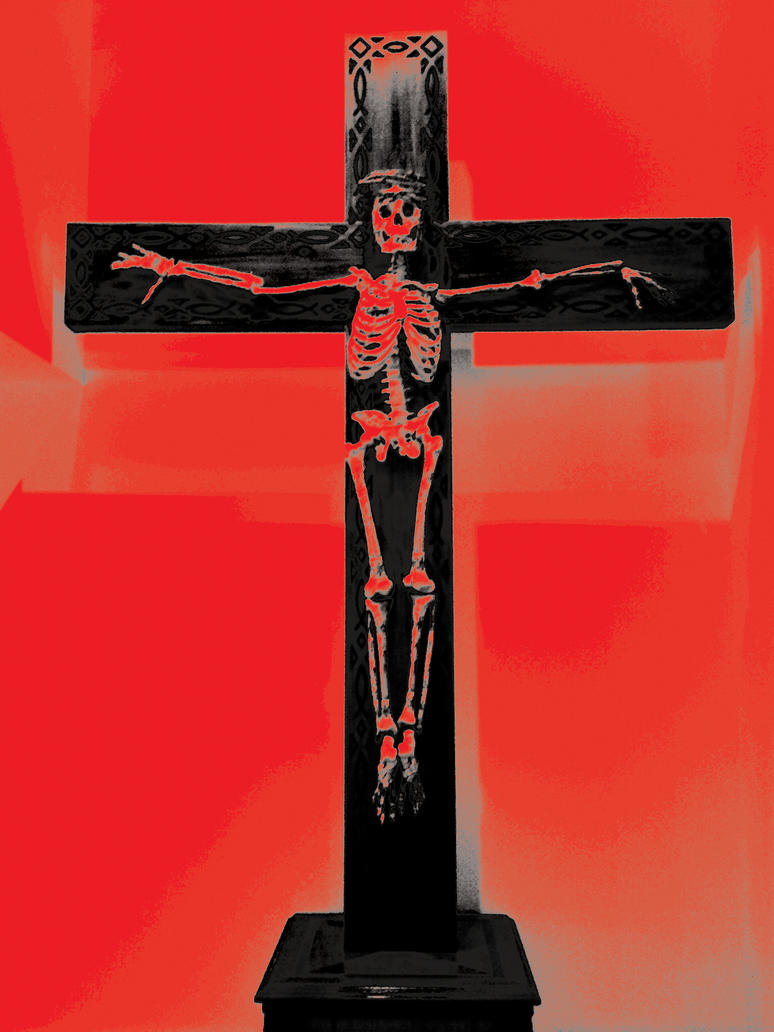
The cross is one of the most recognizable religious symbols known to man.

Millions revere it, considering it to be the sacred instrument on which Jesus was put to death.

Roman Catholic writer and archaeologist Adolphe-Napoleon Didron stated: “The cross has received a worship similar, if not equal, to that of Christ; this sacred wood is adored almost equally with God Himself.”

Some say that the cross makes them feel closer to God when they pray.
Others use it as an amulet, thinking that it protects them from evil.
But should Christians use the cross as an object of veneration?
Did Jesus really die on a cross? What does the Bible teach on this subject?
What Does the Cross Symbolize?

Long before the Christian era, crosses were used by the ancient Babylonians as symbols in their worship of the fertility god Tammuz.
The use of the cross spread into Egypt, India, Syria, and China.
Then, centuries later, the Israelites adulterated their worship of God with acts of veneration to the false god Tammuz.

What is the truth?

The Gospel accounts of Matthew, Mark, Luke, and John use the Greek word stau·ros′ when referring to the instrument of execution on which Jesus died.
(Matthew 27:40; Mark 15:30; Luke 23:26)
The word stau·ros′ refers to an upright pole, stake, or post.

The book The Non-Christian Cross, by J. D. Parsons, explains: “There is not a single sentence in any of the numerous writings forming the New Testament, which, in the original Greek, bears even indirect evidence to the effect that the stauros used in the case of Jesus was other than an ordinary stauros; much less to the effect that it consisted, not of one piece of timber, but of two pieces nailed together in the form of a cross.”

As recorded at Acts 5:30, the apostle Peter used the word xy′lon, meaning “tree,” as a synonym for stau·ros′, denoting, not a two-beamed cross, but an ordinary piece of upright timber or tree.


It was not until about 300 years after Jesus’ death that some professed Christians promoted the idea that Jesus was put to death on a two-beamed cross. However, this view was based on tradition and a misuse of the Greek word stau·ros′.

It is noteworthy that some ancient drawings depicting Roman executions feature a single wooden pole or tree.


Conclusion

There is evidence that Jesus did not died on a cross!
However does it really matters?

But, you know what is so sick about this all?

Suppose a loved one of yours was brutally murdered and the weapon was submitted to the court as evidence.
Would you try to gain possession of the murder weapon, take photographs of it, and print many copies for distribution? Would you produce replicas of the weapon in various sizes?
Would you then fashion some of them into jewelry? Or would you have these reproductions commercially manufactured and sold to friends and relatives to be venerated?

Likely you would be repulsed at the idea!
Yet, these very things have been done with the cross!

If it was a cross or a pole it really doesn´t matter at all. It change nothing.
But that you pray with the murder weapon, the thing that tortured Jesus to death, and carry it around your neck is sick!


Tuesday, July 17, 2012

Suicide forest Aokigahara


Aokigahara, also known as the Sea of Trees, is a 35-square-kilometre forest that lies at the northwestbase of Mount Fuji in Japan.

The forest contains a number of rocky, icy caverns, a few of which are popular tourist destinations. Due to the wind-blocking density of the trees and an absence of wildlife, the forest is known for being eerily quiet.

The forest floor consists primarily of volcanic rock and is difficult to penetrate with hand tools such as picks or shovels.


The forest has a historic association with demons in Japanese mythology and is a popular place for... suicides!


54 completed the act in 2010, despite numerous signs, in Japanese and English, urging people to reconsider their actions.


 There are also a variety of unofficial trails that are used semi-regularly for the annual "body hunt" done by local volunteers.


In recent years, hikers and tourists trekking through Aokigahara have begun to use plastic tape to mark their paths so as to avoid getting lost.


Though officials try to remove the tape time and time again, more tourists and thrill-seekers inevitably leave more of the litter, and a great deal of it lies scattered throughout the first kilometer of the forest, past the designated trails leading to tourist attractions such as the Ice Cave and Wind Cave.


The forest is the most popular place for suicide in Japan and second in the world after San Francisco's Golden Gate Bridge. Statistics vary.
In the period leading up to 1988, about 30 suicides occurred there every year.


Body count

In 2002, 78 bodies were found within the forest, exceeding the previous record of 74 in 1998. In 2003, the rate climbed to 100, and in recent years, the local government has stopped publicizing the numbers in an attempt to downplay Aokigahara's association with suicide. In 2004, 108 people killed themselves in the forest. In 2010, 247 people attempted suicide in the forest, 54 of whom completed the act. Suicides are said to increase during March, the end of the fiscal year in Japan.

The high rate of suicide has led officials to place signs in the forest, in Japanese and English, urging those who have gone there in order to commit suicide to seek help and not kill themselves.
The annual body search, consisting of a small army of police, volunteers, and attendant journalists, began in 1970.

Don`t forget that the forest is 35-scuare-kilometre! So how many body`s aren`t found yet!


Why this forest?

The site's popularity has been attributed to the 1960 novel 'Nami no Tō' ("Tower of Waves") by Seichō Matsumoto, which ends with two lovers committing suicide in the forest.


However, the history of suicide in Aokigahara predates the novel's publication, and the place has long been associated with death: ubasute may have been practiced there into the 19th century, and the forest is reputedly "haunted" by the Yuri (angry spirits) of those left to die.


What is the truth?

Yes this is all true.
I don`t understand why the suicide rate in Japan is so high.
But Japan is surely not the only country with a high suicide rate.
Like in Belgium, suicide is the second highest cause of death.

People are depressed and lonely in these modern times with no hope.

However there is.


In this documentary made by 'Vice' you can see the beauty and horror of Aokigahara!


Sunday, July 15, 2012

Movie: Tomie: Anrimiteddo


Movie review: Tomie: Anrimiteddo
Noboru Iguchi - Japan, 2011
Horror, 85 min.


Tsukiko, who belongs to a photography club at high school, always feels inferior to her elder sister, Tomie. Tomie is breathtakingly beautiful and popular among the male students, including Toshio, whom Tsukiko is secretly in love with.
After one year of the accidentally death of Tomie, the life of her family will change forever.
When suddenly a girl knocks on the door.
The girl claims to be Tomie, back from the death.


One day an awful accident kills Tomie right in front of her younger sister.
Since then Tsukiko suffers from a nightmare night after night.
A year later Tsukiko and her parents are surrounding a birthday cake to celebrate dead Tomie s 18th birthday.


Suddenly they hear an eerie knock at the door.
Unbelievably, it is Tomie. She is back.
The father and mother blindly welcome Tomie in tears, but Tsukiko feels instinctive fear.
Tomie gradually reveals her true face, but only when she is with Tsukiko.
Now Tsukiko s nightmare becomes reality, and the terrifying days begin...


This is one of the many movies based on the manga series 'Tomie' of Junji Ito.

It is hard to describe this movie, because of the bizarre events that happens.
How further to the ending, how more bizarre it gets.

In the beginning we`ll see an unforgettable death scene with amazing effects and camera. And at the ending you will see things you never could have imagine.

Good camera, good acting. Special effect were sometime cheap C.G. but in overall freaky and disturbing enough.
The movie is slow and not really scary. It is more about the gore.
The movie kinda reminds me of 'Funky Forest'.
So if you like bizarre stuff in the Japanese way, you`ll like this movie!


Friday, July 13, 2012

Montauk Monster


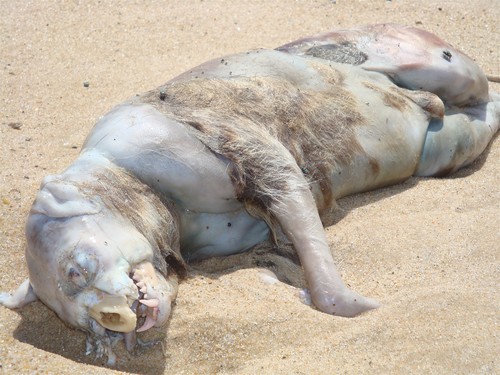
The "Montauk Monster" was an unidentified creature that washed ashore dead, on a beach near the business district of Montauk, New York in July 2008.


The identity of the creature, and the veracity of stories surrounding it, have been the subject of unresolved controversy and speculation.
It is unknown what happened to the carcass.


Although the creature's body was never reported as recovered or physically examined.


The story began on July 23, 2008 with an article in a local newspaper, The Independent. Jenna Hewitt, 26, of Montauk, and three friends said they found the creature on July 12 at the Ditch Plains beach, two miles east of the district.
The beach is a popular surfing spot at Rheinstein Estate Park owned by the town of East Hampton.

A color photograph of the creature ran in black and white under the headline "The Hound of Bonacville" (a take-off on the name Bonackers, which refers to the natives of East Hampton, and The Hound of the Baskervilles which is a book in the Sherlock Holmes series by Sir Arthur Conan Doyle).

The light-hearted article speculated that the creature might be a turtle or some mutant experiment from the Plum Island Animal Disease Center.

There were rumors that the carcass had been taken away from the site.
A local newspaper quoted Aidan Christian, who claimed that the animal was only the size of a cat, and that it had decomposed to a skeleton by the time of the press coverage.
She would not identify its location for inspection.
Hewitt claimed that "a guy took it and put it in the woods in his backyard", but would not say who or where. Her father denied that his daughter was keeping the body's location a secret.


Hewitt and her friends were interviewed on Plum-TV, a local public-access television show.
Alanna Navitski, an employee of Evolutionary Media Group in Los Angeles, California, passed a photo of the creature to Anna Holmes at Jezebel, claiming that a friend's sister saw the monster in Montauk.
Holmes then passed it along to fellow Gawker Media website Gawker.com which gave it wide attention on July 29 under the headline "Dead Monster Washes Ashore in Montauk".

Cryptozoologist Loren Coleman at Cryptomundo first coined the name the "Montauk Monster" on July 29, 2008.
The moniker was disseminated globally on the Internet in the following days. Photographs were widely circulated via email and weblogs, and the national media picked up on it raising speculation about the creature.


Theories

Speculation in published reports included theories that the Montauk Monster might have been a turtle without its shell, even though a turtle's shell cannot be removed without damaging the spine nor do they have teeth as appear in the photograph a dog, a raccoon, or perhaps a science experiment from the nearby government animal testing facility, the Plum Island Animal Disease Center.
The creature's appearance was believed to have been altered through immersion in water for an extended period before coming to rest on the shore, making it difficult to identify.

William Wise, director of Stony Brook University's Living Marine Resources Institute, interpreted the photo along with a colleague; they deemed the creature a fake, most likely the result of "someone who got very creative with latex", although his "next-best guess" was that the creature could be a diseased dog or coyote which had "been in the sea for a while".
Wise discounted the following general possibilities:

Raccoon - the legs appear to be too long in proportion to the body.
Sea turtle - sea turtles do not have teeth, and the body cannot be removed from the shell without doing damage to muscle and skin tissue and the spine.
Rodent - rodents have two huge, curved incisor teeth in front of their mouths.
Dog or other canine such as a coyote - the prominent eye ridge does not match the creature's feet.
Sheep or other ovine - sheep have two-toed hooves, not multi-toed paws.


On August 1, Gawker published pictures and X-ray images of a water rat, an Australian rodent with several similarities to the Montauk Monster, such as the beak, tail, feet, and size.
On the same day, Jeff Corwin appeared on Fox News and claimed that upon close inspection of the photograph, he feels sure the monster is merely a raccoon or dog that has decomposed slightly.

On August 5, 2008, Fox News Channel's Morning Show repeated speculation that the beast is a decayed corpse of a capybara, even though capybaras do not have tails. The next day, the same program reported that an unnamed man claimed that the animal's carcass had been stolen from his front yard.

In a 2009 episode of Monster Quest, cryptozoologist Loren Coleman examined a latex replica of the Montauk Monster's remains and proposed that it was the remains of a raccoon, due to similar body structures and skull shape.


What is the truth?


What is this creature?
Is it an animal from the animal testing facility who escaped?

A beast deformed by cruel tests?

Is it even real?
Or just a well build latex monster, made by people who are against the testing facility and want to scare people with this creature?

A palaeozoologist named Darren Naish studied the photograph and concluded from visible dentition and the front paws that the creature was a raccoon, with its odd appearance merely a byproduct of decomposition and water action removing most of the animal's hair and some of its flesh.

He also showed an illustration of an intact raccoon corpse drawn over the corpse in the photograph. Furthermore he points out the strong resemblance of the skull profile to that of a raccoon, and the long fingers, which are typical of raccoons, and unlike those of other carnivores.


If you look at the skull it is very clear to be a raccoon! So there is nothing special or mysterious about this so called monster.

But the theory of a creature escaped from the Plum Island Animal Disease Center is amazing.
However the truth say otherwise.