Showing posts with label Death. Show all posts

Monday, August 19, 2013

Chainsaw Suicide


David Phyall, a 50-year-old British man, didn't want to leave his apartment block, which was set to be demolished.
Alternative accommodations were offered to him 11 times, but David just wasn't taking.

One by one, all his neighbors moved out, leaving him the sole holdout rattling around in a condemned apartment building all on his own.

Something had to give and it turned out that something was going to be David's vertebrae.
See, he had a plan that was definitely going to cost him his safety deposit, and make a hell of a chore for the cleaning staff.

David tied a chainsaw to the leg of a table, laid down with his neck against it, set the saw on a 15-minute timer, then took a stiff drink and then took a cocktail of pills to knock himself out.
He rested the saw on his neck and once he passed out, the timer went off – slicing through his neck in an instant.


Cops and paramedics found his blood-soaked corpse ten days ago after his dad John raised the alarm.

A Hampshire police source said: “What greeted them was a horrific sight. The head was severed and there was a considerable amount of blood.

“He seemed to have gone into a great amount of detail to end it all.”


What is the truth?

This is unfortunately a true story.

Ron Turtle, residents’ association chairman, said: “They offered him several places that were similar but he just didn’t want to move. They had to go to court. It is a very sad situation.”

Chainsaw suicides happens.
There is word off cases that people saw there head off by a dare or bet.

Drunk? Depressed? Angry? Stay away from chainsaws!
Or friends with a chainsaw...


Sunday, May 5, 2013

The Sausage Murders


1864, in an emergent town in the South of Brazil called Porto Alegre (lit. “Happy Harbour”), a crime shocked its citizens and could make even Sweeney Todd a bit disgusted.

The “Crime na Rua do Arvoredo” or how it’s sweetly called around Brazil “The Sausage Murders”.


The story

Around in 1860, Rio Grande do Sul (lit. “Big River of the South”), which is one of the three South states of Brazil, was facing tons of revolutionary wars - Porto Alegre was not directly involved in them, but since it was the capital of Rio Grande do Sul, news about the wars spread widely through the (then) small town: nothing more than 20 thousand people lived there.
It was also brimming with German and Italian immigrants that came to the city with dreams of prosperity and the promise of a new life.

It was when one of these immigrants, a German butcher working in the city at the time called Carl Goetibb Clausser suddenly disappeared, and was replaced by an ex police officer called José Ramos, that things started to get really weird.

Ramos had a beautiful wife called Catarina Palsen, who was of Hungarian descent (apparently born on Transylvania - what a nice coincidence).
She had wonderful long blonde hair, shiny blue eyes and a curvaceous body - rumor has it that men could not resist her charms.

And that’s exactly how Ramos lured his victims into his trap.

As soon as Catarina got her hand on another man, she’d whisper him sweet words and take them to her house, claiming that her husband, the butcher, “wouldn’t be home for a while”.
She would then make love to them and serve them a wonderful supper afterwards - that’s when Ramos would come out of the darkness and smash a hatchet right into their heads, dropping them through a whole on the ground craftily done so it wouldn’t raise any suspicions.
If the victims happened to still be alive, he’d cut their throats with a knife meticulously.

Then, Ramos would go down to the secret room with Catarina, take off the victim’s clothes and belongings and turned them into meat - more specifically into sausages, which he sold at the public market.

And the most terrifying thing is that it was extremely well-received, and people would get into long, long lines just to get Ramos special sausage... without even knowing what they were made of.

“It’s a special meat. A secret.” Ramos would say with a devilish smirk that his costumers didn’t quite catch while gorging themselves on the meat.

When asked where did Mr. Clausser went, Ramos would only say that the man sold the store to him and left back home to Germany.

This didn’t really raised much suspicions; it wasn’t until a sixteen year old boy and a salesman disappeared that the police got involved.
As soon as they went to search the house after the neighbours heard a scream, probably the boy, the police found out the carcasses of the bodies that the couple used to make their famous sausage, including the body of Mr. Clausser, and soon they were taken in and arrested for slaughter.


The aftermath

Since José Ramos was an ex-policeman (that was discharged because of his extreme violence - going so far as almost killing another policeman over a lost bet) and also a close friend of the general that followed his case, Mr. Dario Callado (that was as violent as Ramos was), his sentence for life was filled with regalies, and he died comfortably only on the year of 1893, from lepra, two years after Catarina had died, mentally ill, in an asylum.

Catarina was actually the one who cooperated with the police; she told them all about the murders and how they planned it all, whilst Ramos didn’t really said anything.
In fact, he pleaded innocent for all the charges dropped on him.
He never told his reasons and how many people he killed, leaving a mist of mystery into the murders that will never be revealed.

The journals of the time tried to tamper down the case, and only internationally it was recognized and widespread (particularly in France and Uruguay) - apparently to try and make the citizens of Porto Alegre forget that they had inadvertently became cannibals for a while.
Actually, it appears that the citizens themselves didn’t want to talk about the crime after it was solved. Nevertheless, it was spread to the city like fire, and even now we still hear and comment on the case, being pass on by families like you would a dead grandfather’s watch or something as equally unique and keep-safe.


The street where it all happened is now called Rua Fernando Machado, and most of the places there maintain the architecture of those times.
Most of the houses on the street carry a eerie sort of look to them and most are abandoned.
The house where the murder happened was demolished, and only the trees from the old Arvoredo Street are still up.


What is the truth?

The most chilling thing about this case was that it was actually real.

A journalist/writer/historian called Décio Freitas, having listened about this story for his whole life but never given actual proof about it went to find them himself.
Freitas found most of the documents for the crime’s judgment, and even if most of them were written in archaic portuguese that was almost impossible to understand, were missing lots of information and lack of some important documents, a huge part of it was more than enough to prove the crime’s existence.

Freitas went on to write a nice detailed book on the case, called “O Maior Crime da Terra” (lit. “The Greatest Crime on Earth”, 1996).

There’s also a fictional take on the murders called “Canibais: Paixão e Morte na Rua do Arvoredo” (lit. “Cannibals: Passion and Death on Arvoredo Street”, 2005 ) written by David Coimbra.

I don’t think either of them were translated into other languages, but if you can get a copy of it on your language read ‘em.
They’re great and go into deep detail on the case.

I guess the moral of the story is “be careful what - or whom - you eat.”

Wednesday, February 13, 2013

Spontaneous Human Combustion


Imagine that you’re sitting quietly on a nice cozy afternoon.
You’re reading your favorite book and no worries crosses your mind.
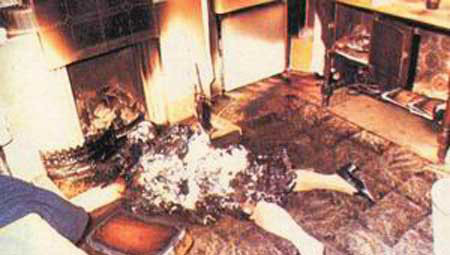
Suddenly, you feel heat grow all through your body, and after a few moments you’re engulfed by flames, leaving nothing but a faint smell of burnt barbecue and your cremated remains behind.

To burn a body you only need two things: intensely high heat and a flammable substance.
For example; You poor gasoline in someone’s body and then light it up. Or your still lit cigarette falls from your lips when you fall asleep.

Spontaneous Human Combustion, as the name already says, is when a human being suddenly burst into flames without any clear sort of either of these two thing.
Although the reason why is not very clear, many reasons are being studied - not only by scientists, but by paranormal experts who say that there’s something else beyond chemicals behind this phenomena.

There has been about 200 filed cases on SHC - the latest of which happened in 2010 when an Irish man named Michael Faherty, 76 years old, died at his home in Galway on 22 December.
Policemen say that the fire “destroyed only the body, the ceiling above him and the floor underneath him.”

No other forms of ignition were found, thus leading the coroner to label his death as “Spontaneous Combustion”.
It is a bit disconcerting that something like this happened not so long ago.


Other real cases


Dr. John Irving Bentley (1966 - Coudersport, Pennsylvania)

When Mr. Gosnell, a meter reader, went to Dr. Irving’s house on a December morning, he couldn’t really expect to see the 92-year-old Doctor turned to dust, but well, it was what he did in fact find.


The only thing left of the Dr. was his lower left leg, with a shoe still on, and dark ashes.

The coroner would only state that the physician died of “death by asphyxiation and 90 percent burning of the body.” But what could’ve caused this? One of the theories was that he slept with his pipe still on - but his pipe was far away and seemingly unused; there were no other sources of fire.
It also seemed that Dr. Bentley’s fire started in his bedroom while he was asleep.
He then woke up, ran to the bathroom (probably to try and water down the fire), but met his demise there, where his remains found the next morning.


Mary Reeser (1951 - St. Petersburg, Florida)

Mary Reeser’s landlady was the one who found her - well, not literally found her, but as she went into Mrs. Reese's apartment to give her a telegram, she found that the doorknob to the apartment was incredibly hot. Fearing for her tenant safety, she called the police.
Mary was nothing but piles of ash and legs (with her shoes still on!), and a incredibly shrunken skull which people said it was “the size of a teacup” when they found her.


Even if such shrinking is not unheard of, since the heat could cause the skull to diminish, people still took it as a paranormal phenomenon in itself, bringing a lot of attention to the case on those good ol’ times.


Phyllis Newcombe (1938 - Chelmsford, England)

27 year old Phyllis was just going down the stairs at Shire Hall after a ball, when her dress suddenly caught on fire. She then ran back into the ballroom looking for help, but collapsed unconscious on the floor.
People aid her, but she unfortunately died a few days later in the hospital.
There was no fire nor source of heat around, and witness say that her dress literally just caught on fire.


These are only some of the many known victims.


What is the truth?

There are a lot of theories out there that try to explain what the hell goes on in such circumstances, but so far there isn’t a certain fact regarding SHC.
The most popular theory is that fire starts when methane (a flammable gas that has a wide distribution in nature) sparks and builds up in the intestines and gets ignited by enzymes (proteins in the body that act as catalysts to induce and speed up chemical reactions).
But since most SHC victims had more damage to the outside of their bodies rather than the insides, this theory seems unlikely.


One of the most possibles explanations is what scientists call “The Wick Effect”, that proposes that the body, when lit by a cigarette, smoldering ember or whatever other heat source, acts much like an inside out candle.

So, is there anything paranormal about this?
It is likely that a human body could go through such experience without the need of a supernatural source, and maybe the cause of the fire can’t be found because it got completely burned with its owner, like a cigarette or a match.
But it is something beyond our current comprehension.
And one of the many things science can not explain.

And with this, I say... keep cool.


Tuesday, October 16, 2012

The Exploding Indian


During an autopsy in Brussels, two coroners were working on the body of an Indian man.

One of the coroner was smoking a cigar during the autopsy.
But when the medical examiner planted his knife in the belly of the Indian man, a foreign gas came free.

When the coroner came closer to the body, the Indian man explode!

The gases were from a pesticide to kill cockroaches. 
The court is still looking out of the man took the poison himself or got killed by someone.


What is the truth?


The story was published in a Belgium newspaper on 17 November 2001.

This story should be true.

However, after some recherche, I could not find the actual story.
So no hard evidence here.


Is it scientific possible?

Yes.
There was an similar accident in Texas, USA 

Family members who gather at a Texas funeral home to mourn the death of 38-year-old Robert Cavazos Jr. reeled in horror when the dead man’s corpse suddenly exploded.

The force of the blast ripped open Cavazos’ cement-lined coffin and filled the funeral home in Raymondville, Texas with “a horrendous, foul oder,”
The lawyer said Cavazos’ body exploded because it was not embalmed and gases formed within the corpse as the decomposition process occurred.

Thursday, September 6, 2012

Issei Sagawa


Issei Sagawa was born in Kobe, Hyōgo Prefecture, Japan to wealthy parents.
He attended the University of Paris.


On the afternoon of June 13, 1981, the Japanese man walked to the Bois de Boulogne, a park on the outskirts of Paris, carrying two suitcases.

The contents of those suitcases, to the lament of a nearby jogger, was the dismembered body of a fellow student.

A Dutch woman named Renée Hartevelt, whom Sagawa had shot three days prior and had spent the days since eating various parts of her body!


He was soon arrested.
According to reports, Issei uttered, "I killed her to eat her flesh," when they raided his home, whereupon they found bits of Renne still in his fridge.

Sagawa was declared insane and unfit for trial and was institutionalized in Paris.
His incarceration was to be short, however, as the French public soon grew weary of their hard-earned francs going to support this evil woman-eater, and Issei was promptly deported.
Herein followed a bizarre and seemingly too convenient set of legal loopholes and psychiatric reports that led doctors in Japan declaring him "sane, but evil."

On August 12, 1986, Sagawa checked himself out of Tokyo's Matsuzawa Psychiatric hospital, Due to loopholes in the law, Issei is a free man to this day.


What is the truth?

This is a true story.

Sagawa now lives in Tokyo and is a minor celebrity in Japan. He was often invited as a guest speaker and commentator throughout 1986-1997.
He has also written restaurant reviews for the Japanese magazine Spa. In 1992, he appeared in Hisayasu Sato's exploitation film Uwakizuma: Chijokuzeme (Unfaithful Wife: Shameful Torture) as a sadosexual voyeur.

Besides books about the murder he committed, Sagawa wrote a commentary book Shonen A in 1997 on the Kobe child murders of 1997, when a 14-year-old referred to in the media as "Seito Sakakibara" and "Boy A" ("Shōnen A") killed and decapitated a child and attacked several others.


Despite this early freelance work, Sagawa can no longer find publishers for his writing and has been rejected from over 500 different places of employment.
Each job application requires writing his resume out in longhand.
He was nearly accepted by a French language school because the manager was impressed by his courage to use his real name, but employees protested and he was rejected.

In 2005, his parents died.
He was prevented from attending his parents' funeral, but he repaid their creditors and moved into public housing. He received welfare for some time but no longer does so.

In an interview with Vice magazine in 2009, he expressed suicidal thoughts and said that being forced to make a living while being known as a murderer and cannibal was a terrible punishment.

WARNING: This video contains extreme content matter which most will find disturbing! 
Do NOT watch if younger then 18! The video contains sexual and gore scenes. 
Viewer discretion is required and advised!


Thursday, August 9, 2012

Namakubi video


In the search of scary video clips you sometimes find a video that is so weird and disturbing you can`t explain what is really going on.
Is it real? Fake?

Sometime you just can`t know.

Watch this video clip closely. Alone and in the dark.
Look closely at the environment and the lighting.


Did you had the feeling the face moved?
Did you saw the lighting chance on her face?

I love the hole scene in it.
The detail of the room,the TV, closet, the box.


What is the truth?


I love this video! This will scare everybody. And leave you with a really bad feeling.

Only the scream at the end kinda ruined the hole scene.

I have tried to translate most of the Japanese texts.

So the title says Namakubi.
Namakubi means “freshly severed head”, which is a reference to Samurai culture, specifically, the presentation of the heads of the vanquished to the leader of the victorious.

But in these days it is used in art form, drawings and tattoos.

When I look at the comments of the video, it looks like it is some kind of competition. To create a scary video with the theme Namakubi.


Someone said in the comments that he filmed it in daylight so it would be darker in the closet.

Well, I say the creator really succeed in creating a freaky and disturbing video!

Tuesday, August 7, 2012

Boiled brains


Milagros Esteves was a fine girl, but not too bright. One day she got asked a date by one guy she really liked, so on the day of the date she wanted to look pretty.


The day came but she never showed up and as days went by her boy decided to pay her a visit in order to know what happened. Telephone calls didn't work so he went to her home and after waiting for an answer he decided to take a look inside from the back part of the house which had a window to the kitchen only to find out his date laying on the kitchen's floor.

When police arrived they could reconstruct the girls last moments.

As time for the meeting came closer Milagros noticed her hair was still too wet to be combed so an idea struck her mind.

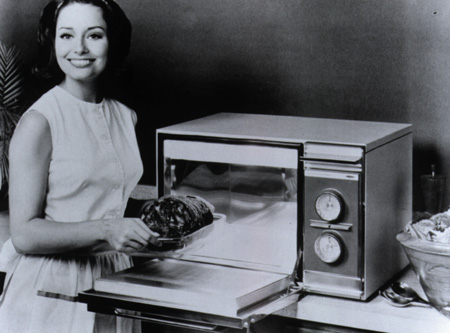
She would go to the kitchen, get a knife, head for the microwave oven, open its door, falsely lock the door in order to keep it open and dry her hair by placing her head inside the oven.

Doctors diagnosed death by boiled brain.


What is the truth

This cautionary tale dating from the 1970`s is essentially a variant of "The Microwaved Pet," in which an elderly woman unfamiliar with the properties of her brand-new microwave oven attempts to use it to dry her wet poodle. It has a similarly gory ending.

First invented in the 1940s, microwave ovens (or "radar ranges," as they were known early on) didn't become affordable enough for most Americans to own until the late 1960s, so they were still something of a novelty when these stories first began to circulate.
They illustrate how new and unfamiliar technologies beget cautionary tales, especially when their workings are obscure and the products are accompanied by bold-lettered safety warnings.


But that this story is true is unknown.
The story is from the 1970`s, so to find hard evidence wouldn`t be easy. Also I can`t find any information about the girl.
So it could be just a cautionary tale.

Tuesday, July 17, 2012

Suicide forest Aokigahara


Aokigahara, also known as the Sea of Trees, is a 35-square-kilometre forest that lies at the northwestbase of Mount Fuji in Japan.

The forest contains a number of rocky, icy caverns, a few of which are popular tourist destinations. Due to the wind-blocking density of the trees and an absence of wildlife, the forest is known for being eerily quiet.

The forest floor consists primarily of volcanic rock and is difficult to penetrate with hand tools such as picks or shovels.


The forest has a historic association with demons in Japanese mythology and is a popular place for... suicides!


54 completed the act in 2010, despite numerous signs, in Japanese and English, urging people to reconsider their actions.


 There are also a variety of unofficial trails that are used semi-regularly for the annual "body hunt" done by local volunteers.


In recent years, hikers and tourists trekking through Aokigahara have begun to use plastic tape to mark their paths so as to avoid getting lost.


Though officials try to remove the tape time and time again, more tourists and thrill-seekers inevitably leave more of the litter, and a great deal of it lies scattered throughout the first kilometer of the forest, past the designated trails leading to tourist attractions such as the Ice Cave and Wind Cave.


The forest is the most popular place for suicide in Japan and second in the world after San Francisco's Golden Gate Bridge. Statistics vary.
In the period leading up to 1988, about 30 suicides occurred there every year.


Body count

In 2002, 78 bodies were found within the forest, exceeding the previous record of 74 in 1998. In 2003, the rate climbed to 100, and in recent years, the local government has stopped publicizing the numbers in an attempt to downplay Aokigahara's association with suicide. In 2004, 108 people killed themselves in the forest. In 2010, 247 people attempted suicide in the forest, 54 of whom completed the act. Suicides are said to increase during March, the end of the fiscal year in Japan.

The high rate of suicide has led officials to place signs in the forest, in Japanese and English, urging those who have gone there in order to commit suicide to seek help and not kill themselves.
The annual body search, consisting of a small army of police, volunteers, and attendant journalists, began in 1970.

Don`t forget that the forest is 35-scuare-kilometre! So how many body`s aren`t found yet!


Why this forest?

The site's popularity has been attributed to the 1960 novel 'Nami no Tō' ("Tower of Waves") by Seichō Matsumoto, which ends with two lovers committing suicide in the forest.


However, the history of suicide in Aokigahara predates the novel's publication, and the place has long been associated with death: ubasute may have been practiced there into the 19th century, and the forest is reputedly "haunted" by the Yuri (angry spirits) of those left to die.


What is the truth?

Yes this is all true.
I don`t understand why the suicide rate in Japan is so high.
But Japan is surely not the only country with a high suicide rate.
Like in Belgium, suicide is the second highest cause of death.

People are depressed and lonely in these modern times with no hope.

However there is.


In this documentary made by 'Vice' you can see the beauty and horror of Aokigahara!


Thursday, June 28, 2012

Cannibal Girl


You are what you eat...
or
You are WHO you eat...

Some say you can tell a loth about a person by looking in his refrigerator.

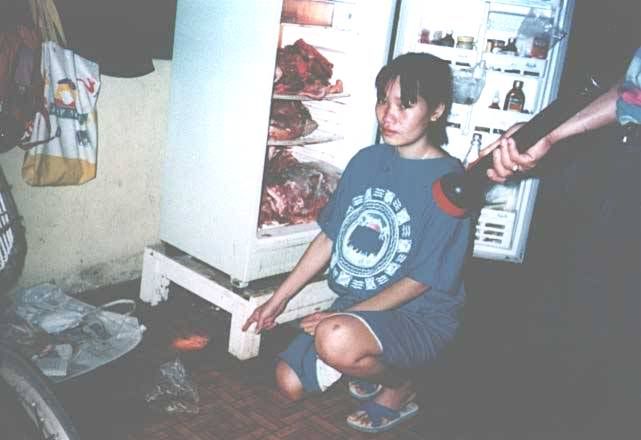
So let`s see what is inside this woman her fridge.


Human meat...


This woman was well known for her amazing cooking. She cooked for her husband and at party`s with relatives and friends.

People always asked her for her cooking secrets, but she never answerd.

She gave them human flesh to eat without their knowledge.

At the end the woman confessed that she killed her husband and ate his flesh.

The act of this woman had been compromised by the local police, now she is ready to accept punishment for the murders she committed.


What is the truth?

All the articles I found were very short. Some say the woman was from South Philippines but other say she is not.
I can`t find from what town, or what her name is.

How many she killed is unknown, some say she only ate men or children.

The only thing there is are the three photographs.
They look real.
And the woman has that guilty look on her face.


There are many cases of cannibalism all over the world, so this could be true.


Saturday, June 23, 2012

Tower Of Silence

The tower of silence.

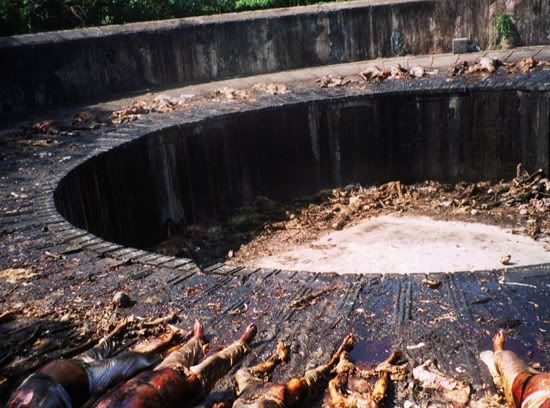
Indian officials investigating several missing persons reports from a nearby city.

What they found was a “Tower of Silence,” or dakhma.
Zoroastrians use these sites to dispose of bodies in the open air!
While sites like these are not uncommon in certain parts of India, several peculiarities hint at something more unusual…


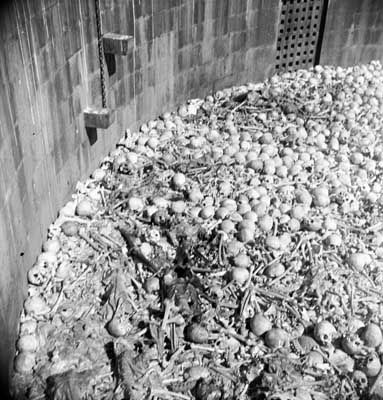
None of the bodies depicted in the photograph were identified. Villagers from nearby, though initially surprised at the sheer number of corpses in the dakhma, proved unable to recognize the bodies. The corpses also do not match the descriptions of the missing people.

There were no animals around except for maggots and flies. Zoroastrians rely on birds (i.e. buzzards) to dispose of the bodies, in the belief they are contributing back to the Earth. Officials found the corpses relatively untouched by any sort of animal.

There is no official count of the bodies. In fact, little work was actually accomplished at the site and, perhaps, this is why only one photograph has emerged. Officials avoided the spot – not only because they felt uneasy looking at it, but for the following, as well:

The deep pit in the center of the photograph was filled with several feet of festering blood – far more than the bodies on the outside could ever supply. The stench was so unbearable that many of the officials began to get nauseous when they first approached the dakhma.

The expedition was ended when a villager accidentally kicked a small bone into the pit, penetrating the coagulated surface of the pool. A massive burst of gas from the decomposing blood erupted from the pit, splashing those looking into it, along with the photographer.
Those caught in the explosion were immediately sent to the hospital, where they were quarantined for possible infection. They became delirious with fever, shouting about “being tainted with the blood of Ahriman” (the personification of evil in Zoroastrianism), despite never having admitted having any familiarity with the religion.

In fact, many of them had no idea what the dakhma was when they had found it. Delirium turned to insanity as many began to attack hospital staff until they were sedated. The fever eventually killed all of them.
When officials returned with HAZMAT gear the following day, the site was empty. All the bodies had been removed and, astonishingly, the pool of blood in the pit had been drained. All that remained of the incident was this photograph.


What is a 'Tower of Silence', Dakhma?
These places are real!
The Dakhma is belief to be a circular raised structure used by Zoroastrians for exposure of the dead.
The common Dakhma originally denoted any place of the dead.
The term "Tower of Silence" is a neologism attributed to Robert Murphy, who, in 1832, was a translator of the British colonial government in India.


Zoroastrian tradition considers a dead body, in addition to cut hair and nail-parings, to be unclean. Specifically, the corpse demon was believed to rush into the body and contaminate everything it came into contact with, hence the Vendidad (an ecclesiastical code "given against the demons") has rules for disposing of the dead as "safely" as possible.

To preclude the pollution of earth or fire, the bodies of the dead are placed atop a tower and so exposed to the sun and to birds of prey. Thus, "putrefaction with all its concomitant evils... is most effectually prevented."
The towers, which are fairly uniform in their construction, have an almost flat roof, with the perimeter being slightly higher than the center.

The roof is divided into three concentric rings:
The bodies of men are arranged around the outer ring, women in the second circle, and children in the innermost ring. Once the bones have been bleached by the sun and wind, which can take as long as a year, they are collected in an ossuary pit at the center of the tower, where they gradually disintegrate and the remaining material, with run-off rainwater, runs through multiple coal and sand filters before being eventually washed out to sea.


The ritual precinct may be entered only by a special class of pallbearers, called nasellars, a contraction of nasa.salar, caretaker of potential pollutants.
The earliest reference to ritual exposure comes from Herodotus, where the historiographer describes the rites to have been secret, and "vaguely" that these first occurred after the body had been dragged around by a dog or bird. Further, the Magi (a term that eventually came to signify a Zoroastrian priest but may not have meant that in Herodotus' time) practiced this quite openly, before they finally embalmed the corpse with wax and laid it in a trench.

While the discovery of ossuaries (in both eastern and western Iran) dating to 5th and 4th centuries BCE indicates that bones were isolated, that this separation occurred through ritual exposure cannot be assumed: burial mounds, where the bodies were wrapped in wax, have also been discovered. The tombs of the Achaemenid emperors at Naqsh-e Rustam and Pasargadae likewise suggest non-exposure, at least until the bones could be collected. According to legend (incorporated by Ferdowsi into his Shahnameh), Zoroaster is himself interred in a tomb at Balkh (in present-day Afghanistan).

While general exposure of the dead is attested from earliest accounts, the ritual customs surrounding that practice appear to first date to the Sassanid era (3rd -7th century CE). They are known in detail from the supplement to the Sayest ne Sayest, the two Rivayat collections, and the two Saddars. The use of towers is first attested in the 16th century.

What is the truth?

I am not so familiar with the Indian/ Iranian culture and beliefs.
But this is the first time I saw something like this.

It must be horrible to discover a place like this, but if this is what the Zoroastrians beliefs, so be it.

I do not know if they still perform this way of funeral. But they did it some years ago.
I wonder if it is legal? Such a place must be a health hazard!

But what about the story? Did it really happened?
The entire story is based on that first picture.
And with a little investigation, it was easy to see the pit was photoshopt!
And later on, I found the original picture.


The picture was the hard evidence of this story.
But the picture is fake, just like the story.
Still the picture is amazing!
The real deal about the Tower of Silence is really disturbing.