Showing posts with label Medical. Show all posts

Friday, April 26, 2013

Demodex


Demodex is a genus of tiny parasitic mites that live in or near hair follicles of mammals.

Many species of Demodex are known and they are among the smallest of arthropods.

Two species living on humans have been identified: Demodex folliculorum and Demodex brevis, both frequently referred to as eyelash mites.
Both species are primarily found in the face, near the nose, the eyelashes and eyebrows, but also occur elsewhere on the body

Demodex canis lives on the domestic dog.
Infestation with Demodex is common and usually does not cause any symptoms, although occasionally some skin diseases can be caused by the mites.


The adult mites are only 0.3–0.4 millimetre  long, with D. brevis slightly shorter than D. folliculorum.
Each has a semitransparent, elongated body that consists of two fused segments.
Eight short, segmented legs are attached to the first body segment.
The body is covered with scales for anchoring itself in the hair follicle, and the mite has pin-like mouth-parts for eating skin cells and oils which accumulate in the hair follicles.
The mites can leave the hair follicles and slowly walk around on the skin, at a speed of 8–16 mm per hour, especially at night, as they try to avoid light.

Older people are much more likely to carry the mites; about a third of children and young adults, half of adults, and two-thirds of elderly people are estimated to carry the mites.
The lower rate of children may be because children produce much less sebum.
It is quite easy to look for one's own Demodex mites, by carefully removing an eyelash or eyebrow hair and placing it under a microscope.


The mites are transferred between hosts through contact of hair, eyebrows and of the sebaceous glands on the nose. Different species of animals host different species of Demodex; only one zoonosis of Demodex is known.

In the vast majority of cases, the mites go unobserved, without any adverse symptoms, but in certain cases (usually related to a suppressed immune system, caused by stress or illness) mite populations can dramatically increase, resulting in a condition known as demodicosis or Demodex mite bite, characterised by itching, inflammation and other skin disorders.
Blepharitis (inflammation of the eyelids) can also be caused by Demodex mites.
Evidence of a correlation between Demodex infection and acne vulgaris exists suggesting it may play a role in promoting acne.


What is the truth?

You have them!

Yes they are all over you!

Together with the mites we live in harmony!
It is unthinkable to imagine an environment where there are no mites!
Our face may be their home.
They don't usually bother us but they frequently are there.

But sometime ignorance is bliss!


Monday, March 18, 2013

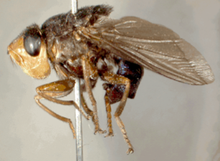
The Bot Fly


Oestridae are a family of flies variously known as bot flies, warble flies, heel flies, gadflies and similar names.

Their larvae are internal parasites of mammals, some species growing in the host's flesh and others within the gut.
The human botfly, Dermatobia hominis, is the only species of bot fly known to parasitise humans routinely, though other species of fly do cause myiasis in humans.

Botflies deposit eggs on a host, or sometimes use an intermediate vector such as the common housefly, mosquitoes and even a species of tick.
The smaller fly is firmly held by the botfly female and rotated to a position where the botfly attaches some 30 eggs to the body under the wings.
Larvae from these eggs, stimulated by the warmth and proximity of a large mammal host, drop onto its skin and burrow underneath.

Eggs are deposited on animal skin directly, or the larvae hatch and drop from the eggs attached to the intermediate vector: the body heat of the host animal induces hatching upon contact or immediate proximity. Some forms of botfly also occur in the digestive tract after ingestion by licking.


Myiasis can be caused by larvae burrowing into the skin (or tissue lining) of the host animal.
Mature larvae drop from the host and complete the pupal stage in soil.
They do not kill the host animal, and thus are true parasites.


The developing on a horse

The equine bot fly presents seasonal difficulties to equestrian caretakers, as it lays eggs on the insides of horse's front legs, on the cannon bone and knees, and sometimes on the throat or nose, depending on the species of bot fly.
These eggs, which look like small, yellow drops of paint, must be carefully removed during the laying season  to prevent infestation in the horse.
When a horse rubs its nose on its legs, the eggs are transferred to the mouth, and from there to the intestines, where the larvae grow and attach themselves to the stomach's lining or they pass into the small intestine and attach there.


The attachment of the larvae to the tissue produces a mild irritation which results in erosions and ulcerations at this site.

Removal of the eggs (which adhere to the host's hair) is difficult, since the bone and tendons are directly under the skin on the cannon bones: eggs must be removed with a sharp knife or rough sand paper, and caught before they reach the ground.
The larvae remain attached and develop for 10–12 months before they are passed out in the feces. Occasionally horse owners will report seeing the bot fly larvae in horse manure.


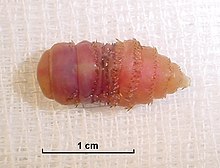
These larvae are cylindrical in shape and are reddish orange in color. In 1–2 months adult bot flies will emerge from the developing larvae and the cycle will repeat


The human botfly

The human botfly occasionally uses humans as the host to its larvae.
The larva, because of its spines, can pose an extremely painful sub-epidermal condition.
Removal processes include placing raw meat on to the area, which in theory will coax the larva out.

Another option is to use the tree sap of the matatorsalo, found in Costa Rica, which is reputed to kill the larva, yet leave its body in the skin.

Additionally, one can attempt to seal the breathing hole of the larva with nail polish or vaseline and then, after a day, squeeze out the suffocated, dead larva.


Use of adhesive tape can work, but carries additional risk of infection because portions of the larva's breathing tube can be broken off by the tape and make the remainder of the body difficult to remove.


What is the truth?

Ally Vagg en Bryan William went through hell in there vacation in Bolivia as you can see in the above youtube video.

They thought they were dealing with infected mosquito bites until they felt something squirming under their skin.  
When they saw something alive comming out there wounds, they realised they had big larvae in their bodies crawling around.
Vagg and Williams have been pulling seven maggots from wounds on their belly, back and legs.
Still, they have to stay there untill they are cured.


Like the Loa Loa there are so many flies that could ruin your body.

There are many horrors in cities, but maybe even more in the outdoor.
Oh wait... what is that on your face... A zit?

Wednesday, February 13, 2013

Spontaneous Human Combustion


Imagine that you’re sitting quietly on a nice cozy afternoon.
You’re reading your favorite book and no worries crosses your mind.
Suddenly, you feel heat grow all through your body, and after a few moments you’re engulfed by flames, leaving nothing but a faint smell of burnt barbecue and your cremated remains behind.

To burn a body you only need two things: intensely high heat and a flammable substance.
For example; You poor gasoline in someone’s body and then light it up. Or your still lit cigarette falls from your lips when you fall asleep.

Spontaneous Human Combustion, as the name already says, is when a human being suddenly burst into flames without any clear sort of either of these two thing.
Although the reason why is not very clear, many reasons are being studied - not only by scientists, but by paranormal experts who say that there’s something else beyond chemicals behind this phenomena.

There has been about 200 filed cases on SHC - the latest of which happened in 2010 when an Irish man named Michael Faherty, 76 years old, died at his home in Galway on 22 December.
Policemen say that the fire “destroyed only the body, the ceiling above him and the floor underneath him.”

No other forms of ignition were found, thus leading the coroner to label his death as “Spontaneous Combustion”.
It is a bit disconcerting that something like this happened not so long ago.


Other real cases


Dr. John Irving Bentley (1966 - Coudersport, Pennsylvania)

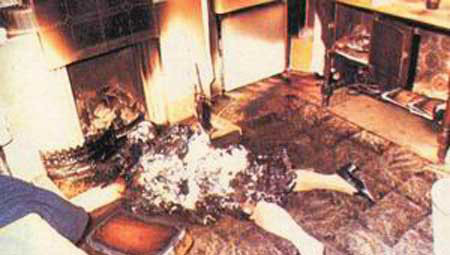
When Mr. Gosnell, a meter reader, went to Dr. Irving’s house on a December morning, he couldn’t really expect to see the 92-year-old Doctor turned to dust, but well, it was what he did in fact find.


The only thing left of the Dr. was his lower left leg, with a shoe still on, and dark ashes.

The coroner would only state that the physician died of “death by asphyxiation and 90 percent burning of the body.” But what could’ve caused this? One of the theories was that he slept with his pipe still on - but his pipe was far away and seemingly unused; there were no other sources of fire.
It also seemed that Dr. Bentley’s fire started in his bedroom while he was asleep.
He then woke up, ran to the bathroom (probably to try and water down the fire), but met his demise there, where his remains found the next morning.


Mary Reeser (1951 - St. Petersburg, Florida)

Mary Reeser’s landlady was the one who found her - well, not literally found her, but as she went into Mrs. Reese's apartment to give her a telegram, she found that the doorknob to the apartment was incredibly hot. Fearing for her tenant safety, she called the police.
Mary was nothing but piles of ash and legs (with her shoes still on!), and a incredibly shrunken skull which people said it was “the size of a teacup” when they found her.


Even if such shrinking is not unheard of, since the heat could cause the skull to diminish, people still took it as a paranormal phenomenon in itself, bringing a lot of attention to the case on those good ol’ times.


Phyllis Newcombe (1938 - Chelmsford, England)

27 year old Phyllis was just going down the stairs at Shire Hall after a ball, when her dress suddenly caught on fire. She then ran back into the ballroom looking for help, but collapsed unconscious on the floor.
People aid her, but she unfortunately died a few days later in the hospital.
There was no fire nor source of heat around, and witness say that her dress literally just caught on fire.


These are only some of the many known victims.


What is the truth?

There are a lot of theories out there that try to explain what the hell goes on in such circumstances, but so far there isn’t a certain fact regarding SHC.
The most popular theory is that fire starts when methane (a flammable gas that has a wide distribution in nature) sparks and builds up in the intestines and gets ignited by enzymes (proteins in the body that act as catalysts to induce and speed up chemical reactions).
But since most SHC victims had more damage to the outside of their bodies rather than the insides, this theory seems unlikely.


One of the most possibles explanations is what scientists call “The Wick Effect”, that proposes that the body, when lit by a cigarette, smoldering ember or whatever other heat source, acts much like an inside out candle.

So, is there anything paranormal about this?
It is likely that a human body could go through such experience without the need of a supernatural source, and maybe the cause of the fire can’t be found because it got completely burned with its owner, like a cigarette or a match.
But it is something beyond our current comprehension.
And one of the many things science can not explain.

And with this, I say... keep cool.


Saturday, January 5, 2013

Maggots In The Brain


This is the case of Mr. Shota Fujiwara, a japanese man from Gifu Prefecture.
He complains incessantly about a persistent headache.
Mr. Shota Fujiwara loves his sashimi and sushi very much to the extent of trying to get them as "alive and fresh" as can be.

He developes a severe headache for the past 3 years and has put it off as migraine and stress from work.


 It was only when he started losing his psycomotor skills that he seeks medical help.

A brain scan and x-ray reveals little however.
But upon closer inspection by a specialist on his scalp, the doctor noticed small movements beneath his skin.

It was then that the doctor did a local anaesthetic to his scalp and discovered the cause when tiny worms crawled out.

A major surgery was thus immediately called for and the extent of the infestation was horrific!

The worms on the head of Shota Fujiwara are actually the parasites that usually found on the body of raw fish.


Another case.

A man gets an ingrown hair on his head.
After some time, it gets infected and the man gets a boil.
Weeks are passing and the boil is still growing every day.

The hair and infection are eroding downwards to his skull.
People keep telling him to go to the hospital for checking his boil.
But he refuse to do so.

The infection reaches his skull.
Bone, once infected, presents little barrier to the spread of infection to contiguous bone and so it spreads within his skull.
The bone dies and begins to erode.

People are noticing a smell and keep telling him to see a doctor.
The smell is starting to attracts flies which begin to lay eggs in his festering wound and maggots take hold.

The infection breaches the inner layer of his skull and reaches the meninges.
Though their tensile strength is impressive the meninges are quite thin and the infection breaches them.

Your brain just isn't supposed to be on your outside and presents almost no barrier to anything when exposed. 
Now, infection and maggots set to work on his brain.

This makes him feel a little wobbly on his feet and he decides to see a doctor.
He walks in to the Stanford ER and doctors found several maggots in his brain.


What is the truth?

This is claimend to be true, but I can not say for shure it really happend.

On the medical matter, maggots can infest the human brain, evidently, and so can certain types of tapeworm larvae.
But these conditions are fairly rare, and the chance of resulting from ingrown hairs or sushi is close to impossible.

Tapeworms and roundworms and their eggs which abounds in all fishes fresh or saltwater can only be killed by thorough cooking and/or freezing the fish to between 4 degC - 0 degsC.
The eggs of these parasites can only be killed if it is cooked or frozen to the said temperatures for a week or more.

Think twice about that raw dish next time... or you might get a headache.


Thursday, July 26, 2012

Brown Recluse Spider


After watching the SpiderMan movie as a kid, I really wanted to be bitten by a spider!
Having the super powers of SpiderMan must be amazing!


Climbing on walls, jumping of buildings, shooting web!
SpiderMan is Awesome!

But in real life things are a little bit different!


There are so many spider species, but there is a nice one in the south of America.


The brown recluse spider or violin spider.

Brown recluse spiders are usually between 6–20 mm, but may grow larger.
While typically light to medium brown, they range in color from cream-colored to dark brown or blackish gray.
These spiders usually have markings on the dorsal side of their cephalothorax, with a black line coming from it that looks like a violin with the neck of the violin pointing to the rear of the spider, resulting in the nicknames fiddleback spider, brown fiddler, or violin spider.

The brown recluse spider is rarely aggressive, and bites from the species are uncommon.
In 2001, more than 2,000 brown recluse spiders were removed from a heavily infested home in Kansas, yet the four residents who had lived there for years were never harmed by the spiders, despite many encounters with them.
The spider usually bites only when pressed against the skin, such as when tangled within clothes, towels, bedding, inside work gloves, etc.

Many human victims report having been bitten after putting on clothes that had not been worn recently, or had been left for many days undisturbed on the floor.


Deadly bites?


The bite frequently is not felt initially and may not be immediately painful, but it can be serious.

The brown recluse bears a potentially deadly hemotoxic venom.

Most bites are minor with no necrosis.
However, a small number of brown recluse bites do produce severe dermonecrotic lesions (i.e. necrosis); an even smaller number produce severe cutaneous (skin) or viscerocutaneous (systemic) symptoms. In one study of clinically-diagnosed brown recluse bites, skin necrosis occurred 37% of the time, while systemic illness occurred 14% of the time. In these cases, the bites produced a range of symptoms common to many members of the Loxosceles genus known as loxoscelism, which may be cutaneous and viscerocutaneous.
In very rare cases, bites can even cause hemolysis—the bursting of red blood cells.

Most brown recluse bites do not result in necrosis or systemic effects.
When both types of loxoscelism do result, systemic effects may occur before necrosis, as the venom spreads throughout the body in minutes.

Children, the elderly, and the debilitatingly ill may be more susceptible to systemic loxoscelism.
The systemic symptoms most commonly experienced include nausea, vomiting, fever, rashes, and muscle and joint pain.
Rarely, such bites can result in hemolysis, thrombocytopenia, disseminated intravascular coagulation, organ damage, and even death.


Most fatalities are in children under the age of seven or those with a weak immune system.


What is the truth?


While the majority of brown recluse spider bites do not result in any symptoms, cutaneous symptoms occur more frequently than systemic symptoms.
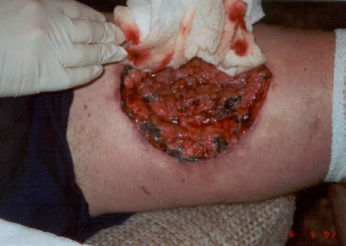
In such instances, the bite forms a necrotizing ulcer that destroys soft tissue and may take months to heal, leaving deep scars.
These bites usually become painful and itchy within 2 to 8 hours.
Pain and other local effects worsen 12 to 36 hours after the bite, and the necrosis develops over the next few days.
Over time, the wound may grow to as large as 25 cm.
The damaged tissue becomes gangrenous and eventually sloughs away.


Here we can see the progressive deterioration of a necrotic wound caused by the venomous bite of a brown recluse spider!


Brown Recluse Spider Bite

Brown Recluse Spider Bite Pictures

Brown Recluse Spider Bite Pictures

Brown Recluse Spider Bite Pictures

Brown Recluse Spider Bite Pictures


I love the nature!
But don`t panic to much.
Unlike the example in the preceding photos, the majority of brown recluse bites are "uneventful," doctors say, and rarely progress to such a serious stage.

Getting a spider bite? No thank you.


Friday, July 6, 2012

Loa Loa


Many have the fear to have a parasite living inside their body.
An unwelcome guest crawling inside their body.


What would you think about a worm living inside...the human eye.


Loa loa is a thread-like worm that lives under the skin in the subcutaneous fat causing loiasis.
Because it is often spotted migrating in the eye, it is known as the eye worm.
Loiasis is endemic to 11 countries and 12 million Africans are infected.
The disease is also known as subcutaneous filariasis, Calabar swellings, African eye worm infection, Loa loa filariasis and Fugitive swelling.


Loiasis is carried by day-biting deer and mango flies (Chrysops silacea and Chrysops dimidiata). They both live in rain forests and warm swamps in central and western Africa. Deer fly's bite is very painful because it has to rip skin apart in order to drink blood. It does not have a narrow sophisticated feeding tube like that of a mosquito. A deer fly is about 5–20 mm in length.


The life cycle of Loa loa starts, when a Loa loa female gives birth to living microfilariae (prelarval eggs) inside the skin of an infected human. The microfilariae travel in peripheral blood during daytime, but during the night (noncirculation phase) they reside in the lungs. When a noninfected deer fly takes a blood meal from an infected human, it ingests microfilariae. The microfilariae lose their sheaths, migrate from the fly's midgut to the hemocoel and eventually to the thoracic muscles. There they develop into first stage and eventually into third stage (infective) filarial larvae. The development inside the fly takes up to two weeks. They migrate to the fly's proboscis (the snout) and invade another human during the next blood meal. The third stage larvae are transferred from the deer fly's mouth parts to the skin. They burrow into the bite wound and enter the subcutaneous layer where they mature into adults in one year. The cycle is completed, when male and female mate and release microfilariae into the bloodstream. Loa loa adults live up to 17 years.


Adult Loa loa male is about 30–34 mm long and 0.35–0.42 mm thick; Loa loa female about 40–70 mm long and 0.5 mm thick. Loa loa migrates in the subcutaneous layer.
When it stops moving, the surrounding tissue develops Calabar swelling. This often occurs in joints, which are its usual stopping points.
If an adult Loa loa is killed, its body becomes waste, which causes abscesses and pus.
The waste products need to be eliminated to make sure that the surrounding tissue and cells are not disturbed.
If the body cannot get rid of the waste, it restricts it by fibrosis.


Loiasis can be asymptomatic.
Native people are more likely to have symptoms than tourists. Adult worms (both living and dead) and their metabolic byproducts (waste) can cause localized subcutaneous itching and allergic reactions. The inflammation may cause red skin eruptions and swelling in the deeper layers of the skin which can last many weeks. Migrating adults can cause instant pain, when moving in sensitive areas, for example, across the surface of the eye. Loiasis is often the cause of eosinophilia (large quantities of eosinophil granulocytes, white cells, that use antigens and special proteins to fight against foreign organisms such as parasites.).


Other symptoms that may occur:
  • arthritis (joint pain)
  • colonic lesion (damaged large intestine)
  • inflammation, swelling and accumulation of fluid in testicles
  • lymphadenitis (infection of the lymph glands)
  • membranous glomerulonephritis (kidney disease)
  • peripheral neuropathy (damaged peripheral nervous system)
  • retinopathy (damaged retina (thin layer on the back wall of the eye)).


But don`t worry, it can be treated.


Aldo the treatment is not innocent!


Loiasis is usually treated with diethylcarbamazine (DEC) or sometimes with ivermectin. Both drugs have severe side effects which include death. DEC is effective against microfilariae and less effective against adult worms.
Treatment with DEC is not advised for patients with high quantities of microfilariae because those patiens can develop encephalopathy (brain disease).
When side effects need to be minimized, albendazole can be used instead.


Sometimes eye worms can be removed surgically, although the time frame during which the removal must be done is very short. After the surgery, DEC therapy should follow to manage other adult worms and microfilariae.


What is the truth?

Yes this creature does exist!

And for the true horror;

An Indian doctor did a strange and unappetizing discovery when an older man with pain and swelling in his eye came into his practice. A worm of 13 cm nested in his eye.

The 75-year-old man underwent emergency surgery to prevent damage to his eye. The doctor did so through a small opening in the conjunctiva to remove the parasite.


Can you imagine, a 13cm worm crawling inside your eye.


Now go check your eyes in the mirror... you never know.